A seven-lesson explorer of why making money in the stock market is harder than it looks!
⚖️ Loss Asymmetry — Move the loss slider and see instantly how lopsided the recovery requirement is. A −50% loss needs a +100% gain to break even; a −90% loss needs +900%. The table at the bottom compares recovery requirements for every loss size side by side.
🎲 Sequence of Returns — Simulates the exact same 15 annual returns in reverse order. The person whose bad years come first and the person whose good years come first end up with dramatically different final balances — despite identical returns. See first-hand why a market crash right after you retire is so catastrophic.
📉 Volatility Drag — Graphs the gap between the arithmetic average (the return advertised) and the compound return (the money you actually make). The higher the volatility, the wider the gap between what the fund says and what lands in your account. Formula: Compound return ≈ Average − (Volatility² ÷ 2).
⏰ Market Timing — Missing just the 10 best trading days over 12 years roughly cuts your return in half. The critical insight: the best days always cluster immediately after the worst crashes — so if you panic-sell, you almost always miss the recovery.
😨 Emotional Traps — The full cycle plays out automatically: Excitement → Buy → Euphoria → Buy More → Denial → Panic Sell → Regret → FOMO Buy Again. The emotional investor's final return is shown in real time against a simple buy-and-hold benchmark.
💸 Fees & Costs — A 1.5% annual fee silently destroys roughly 30% of your wealth over 30 years. The chart compares the compounded difference between an index ETF (0.03%) and an actively managed fund (1.5%) over three decades.
🎮 Trade Simulator — Hit BUY and SELL yourself and try to time the market. Experience first-hand just how difficult it is to beat it — 80% of professional fund managers fail to outperform a simple index over the long run.
An eight-topic bacteria and virus explorer!
🦠 Bacteria Structure — The cell wall, cell membrane, nucleoid (DNA), ribosomes, plasmid, flagellum, pili, and cytoplasm are all labelled and animated. The flagella wave in real time, and hovering over any label highlights the corresponding structure.
🔴 Virus Structure — Switch between three virus types: naked capsid (adenovirus), enveloped (influenza / coronavirus), and bacteriophage (T4 phage — head + tail + leg structure). Each type shows its component parts and a list of real-world examples.
⚖️ Bacteria vs Virus — The two are placed side by side and compared across 10 categories: size, genetic material, cell wall, reproduction method, treatment, and more. Makes it immediately clear why antibiotics have no effect whatsoever on viruses.
💉 How Infection Works — A bacterial infection plays out automatically across 5 stages: entry → attachment → colonisation → immune response → resolution. Neutrophils (white blood cells) visibly chase and destroy bacteria in real time.
🔬 Binary Fission — Bacteria double every 20 minutes. The cell elongation, septum formation, and split into two daughter cells are all animated. An exponential growth graph is shown alongside.
🧬 Viral Replication — The lytic cycle unfolds across 6 steps: attachment → entry → uncoating → replication → assembly → lysis. In the final stage the host cell bursts, releasing hundreds of new viruses.
🛡️ Immune Response — Both innate immunity (neutrophils hunting and engulfing bacteria) and adaptive immunity (antibody production) are animated. Once all bacteria are eliminated, an "Infection cleared!" message appears.
📏 Size Comparison — A logarithmic scale runs from a human hair (70 µm) down to a single protein (5 nm). Illustrates the key fact that viruses are invisible even under a light microscope and can only be observed with an electron microscope.
👁 126
👍 1
˚.⋆🪐 ⋆⭒ Milky Way Galaxy ˚.⋆🪐 ⋆⭒
A seven-concept Milky Way explorer!
🔭 Top View — The spiral structure seen from directly above. All four major arms rotate slowly as density waves, just as they do in reality. A panel on the left shows diameter, thickness, star count, age, and galaxy type.
📏 Side View — The disk in cross-section, viewed edge-on. The thin disk (~1,000 ly), thick disk (~3,500 ly), and spherical halo (~200,000 ly) are rendered as distinct layers. Globular clusters (GCs) are scattered throughout the halo.
📍 Our Location — Watch the Solar System orbit slowly through the Orion–Cygnus Spur. Includes the actual orbital speed (~220 km/s), the length of a Galactic Year (~230 million years), and a list of the nearest stars to the Sun.
🌀 Spiral Arms — Click any of the four major arms — Perseus, Sagittarius, Scutum–Centaurus, and Norma — to highlight it in the galaxy view. Each panel shows the arm's key characteristics and distance from the galactic centre.
⚫ Galactic Centre — S-stars trace elliptical orbits around Sagittarius A* (Sgr A*). The relativistic jet, photon sphere, and event horizon are all shown, alongside details of the first-ever image captured by the Event Horizon Telescope in April 2022.
📐 Scale Comparison — A logarithmic scale bar runs from the Earth–Moon distance all the way to the Andromeda Galaxy. See intuitively just how small the Solar System is: if the Milky Way were shrunk to 10 km across, the entire Solar System would be smaller than a bacterium.
📈 Rotation Curve — The gap between the observed flat curve (gold) and the expected Keplerian decline (blue) is the evidence for dark matter. Use the Dark Matter slider to adjust the halo's contribution and watch the curve respond.
👁 146
👍 1
📟 Arduino kit
An eight-project Arduino simulator! Every project includes real Arduino code, a live circuit diagram, and a Serial Monitor at the bottom.
💡 LED Blink — The "Hello World" of hardware. A 220Ω resistor and LED circuit, digitalWrite(13, HIGH/LOW) code, and a PWM timing diagram all run simultaneously.
🔘 Button & LED — A live visualisation of INPUT_PULLUP. Click the button to light the LED, and see the inverted logic (LOW = pressed) explained in context.
🌓 PWM Fade — Controls LED brightness with analogWrite(9, 0–255). The PWM waveform and duty cycle update in real time as the LED breathes.
🌡️ Analog Sensor — Turn the potentiometer dial to read ADC values from 0 to 1023, then watch map() rescale them to the PWM range (0–255). Includes a voltage divider explanation.
⚙️ Servo Motor — Control the servo with an angle slider. The relationship between PWM pulse width (0.5ms – 2.5ms) and output angle is visualised live.
🎨 RGB LED — Mix any colour with the R, G, and B sliders. Press AUTO for an automatic rainbow cycle. A colour wheel is shown alongside.
📡 Ultrasonic Sensor — Shows how the HC-SR04 works with a TRIG/ECHO timing diagram. Verify the formula cm = round-trip time (µs) / 58 directly.
🚦 Traffic Light — Demonstrates a Finite State Machine (FSM). The RED → RED+YELLOW → GREEN → YELLOW cycle runs alongside a live state-transition diagram.
👁 158
👍 1

🪐 Solar System
A six-concept solar system explorer!
🌌 Solar System — All eight planets orbit the Sun at accurate relative speeds. Hover over any planet to see its rotation period, orbital period, axial tilt, and number of moons.
🔄 Rotation vs Revolution — The left panel shows rotation (one day) and the right shows revolution (one year), running simultaneously. See intuitively how Earth completes 365.25 rotations during a single trip around the Sun.
🌍 Earth & Moon — Visualises tidal locking — the phenomenon by which the Moon always shows the same face to Earth. This happens because the Moon's rotation period equals its orbital period: both are exactly 27.3 days. Watch the white marker on the Moon — it never stops facing Earth.
⚡ Orbital Speed — Following Kepler's 3rd Law (T² ∝ r³), inner planets orbit dramatically faster than outer ones. Arrow length represents relative speed — the difference between Mercury (47.9 km/s) and Neptune (5.4 km/s) is striking.
🌡️ Axial Tilt & Seasons — Drag the tilt slider from 0° (no seasons at all) to 98° (extreme) and watch the Northern Hemisphere sunlight percentage update in real time. Experience first-hand that seasons are caused by axial tilt — not by distance from the Sun.
📊 Planet Compare — Select any two planets to compare their rotation period, orbital period, axial tilt, and moon count side by side. You can verify for yourself that Venus's day (243 days) is actually longer than its year (225 days).
👁 154
👍 1
A six-concept explorer of AI-powered cyber attack and defense!
⚔️ AI vs AI Battle — Adjust the Attack AI and Defense AI IQ sliders to trigger a live cyber battle. A high Attack IQ unleashes advanced threats like zero-days and polymorphic malware; a low Defense IQ means the server gets breached.
📊 Anomaly Detection — The AI learns what normal traffic looks like, then flags deviations. Enable Attack Mode to mix in malicious requests, then use the Sensitivity slider to experience the precision-recall trade-off between catch rate and false alarms first-hand.
🎭 Deepfake Attack — A GAN-generated fake face goes up against an AI detector. Raise the Quality slider and pixel artifacts fade, making detection progressively harder. The GAN architecture that produces the deepfake is shown alongside.
🔓 LLM Jailbreak — Step through five real prompt injection techniques — direct request, roleplay framing, DAN persona override, language obfuscation, and authority framing. Lower the Guard Level and watch certain techniques punch through the safety layer.
☠️ Data Poisoning — Increase the poison rate in the training dataset and spam detection accuracy silently collapses. The model appears healthy but starts classifying spam as "Safe Email" — a textbook silent failure, visualised in real time.
🧠 Zero Trust AI — Select one of six users (normal employee, external IP, unusual login time, personal device, and more), press Analyze, and the AI evaluates five factors — IP reputation, access time, device trust, user role, and risk score — to grant or deny access on the spot.
👁 138
👍 1
A six-concept cybersecurity explorer
A six-concept cybersecurity explorer — all concepts are visualised without any real attack code.
🔍 Reconnaissance — A rotating scan beam sweeps across the target network, probing for open ports (SSH, HTTP, MySQL, and more). Every discovered port is logged to the terminal in real time.
🔐 Brute Force — An automated tool fires thousands of password guesses per second. Lower the password strength slider and it cracks in moments; raise it and the time climbs dramatically. Real GPUs can attempt ~1 billion passwords per second.
🎣 Phishing — Renders a convincing fake inbox showing suspicious sender domains and urgency tactics, exactly as a victim would see them. Switch to the "Fake Website" tab to simulate a victim entering credentials into an attacker-controlled login page that looks identical to the real thing.
💉 SQL Injection — Toggle between "Normal Login" and "SQL Injection" to see how a single line — ' OR '1'='1 — bypasses the entire password check and exposes every user record in the database. The correct defense (Prepared Statements) is shown in code alongside.
🔒 Encryption — Alice encrypts a message with an AES key and sends it across the network. An attacker intercepts the packet mid-transit but sees only unreadable ciphertext. Click "SEND ENCRYPTED" to watch the full flow. Estimated crack times for 64, 128, and 256-bit keys are shown for comparison.
🛡️ Firewall & Defense — Live packets stream in from the internet and are either passed or blocked at the firewall. Add more rules with the slider and watch the block rate climb.
👁 162
👍 2
AI | LLM (Large Language Model)
✂️ Tokenisation — Choose one of four sentences and watch the text split into tokens one by one. Just as "unbelievable" might become ["un","believ","able"], the visualiser mirrors GPT-4's approach using a vocabulary of ~50,000 tokens.
🗺️ Word Embeddings — Words like king, queen, man, woman, Paris, and dog are plotted in a 2D vector space. Semantically similar words cluster together, and the king − man + woman ≈ queen analogy is shown with a dashed line. Hover over any word to see its vector coordinates.
👁️ Attention Mechanism — In the sentence "The bank can guarantee deposits…", click any word to see which other tokens it attends to, visualised as weighted arcs. Click "bank" and you'll see strong attention toward "deposits" and "losses" — establishing the financial meaning.
🌡️ Temperature — Predicting the next word after "The model felt ___", slide Temperature from 0.1 (deterministic) to 3.0 (random) and watch the probability distribution reshape in real time. Press the Sample button to experience the actual sampling process.
📜 Context Window — Drag the Context slider down and watch older messages get crossed out as they fall outside the window. An intuitive way to understand GPT-4's 128K token limit and why long conversations feel like the model "forgets" things.
🕸️ Neural Network — A live visualisation of the Transformer layer structure. Adjust the number of layers and neurons and the parameter count updates instantly. An activation pulse animates through the layers to illustrate a forward pass.
👁 120
👍 1
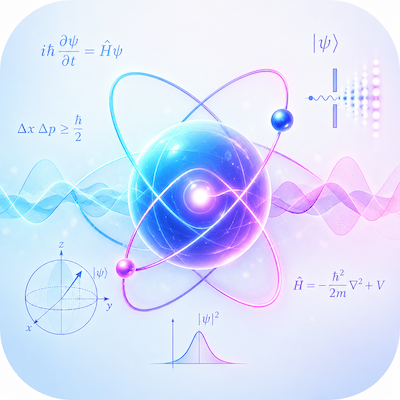
Atom & Electron Explorer
🪐 Bohr Model — Select any element from H, He, Li, C, O, Ne, Na, or Ar to watch its electron orbits drawn in real time. Click the nucleus to trigger a photon burst. An energy level diagram is shown on the right.
☁️ Electron Cloud — Choose from 1s (sphere), 2s (sphere with a radial node), 2p (dumbbell), or 3d (cloverleaf) to see the probability cloud rotate in 3D. Visualises how quantum electrons exist as a probability distribution, not a fixed orbit.
🌈 Emission Spectrum — Select Hydrogen, Helium, or Sodium, then press Excite Electron to watch an electron jump between shells and emit a photon of a specific colour. The real spectral lines for that element are displayed below.
📋 Electron Config — Raise the atomic number Z from 1 to 36 with the slider and watch electrons fill in Aufbau order (1s → 2s → 2p → 3s…) step by step. Includes explanations of Hund's Rule and the Pauli Exclusion Principle.
💥 Nuclear Structure — Adjust the number of protons and neutrons to watch the nucleons vibrate under the strong nuclear force. If the N/Z ratio falls outside the stable range, the nucleus is flagged as unstable. Binding energy in MeV is calculated live.
⚡ Photoelectric Effect — Push the frequency above the 4.5 eV threshold and electrons are ejected. No matter how high you set the intensity, electrons will not be emitted if the frequency is too low — experience first-hand the phenomenon that earned Einstein the Nobel Prize in 1921.
👁 115
👍 1
👽 SETI | Astrobiology
🔭 Drake Equation — Adjust all seven sliders to tune each term and watch the number of civilisations N update in real time. Optimistic settings produce thousands; pessimistic ones drop below one.
🤫 Fermi Paradox — A live simulation of 50 civilisations broadcasting signals outward. Most go extinct before their waves ever overlap. Experience first-hand why "the universe is so vast — yet so silent."
🌍 Habitable Zone — Change the star's mass to shift the Goldilocks Zone. Dial down from a Sun-like G-type to a red dwarf M-type and watch the habitable band shrink to an extremely narrow ring.
⚡ Kardashev Scale — Slide between levels 0 and 3 to explore Type I (planetary), Type II (Dyson Sphere), and Type III (galactic) civilisations — their energy scales and defining characteristics. Humanity currently sits at roughly Type 0.73.
☄️ Panspermia — Microbe-laden asteroids (green) travel between Mars, Earth, Europa, and Enceladus, seeding life on impact. Each successful delivery triggers a burst particle effect.
📡 First Contact — Set the distance and signal strength, then press SEND SIGNAL to watch your transmission travel at the speed of light. At 500 light-years, the round trip takes 1,000 years — and you feel every second of it.
👁 123
👍 1
Theory of relativity
🛗 Equivalence Principle — Switch between the Rocket, Both, and Gravity views to see that the physics inside an accelerating rocket and on Earth's surface are completely identical. This single insight was Einstein's starting point for General Relativity.
⚡ E = mc² — Set the mass with the slider, then press CONVERT to see the energy released and its TNT equivalent. A visceral demonstration of just how much energy is locked inside even a small amount of matter.
🌐 Curved Spacetime — Drag the sun to a new position and watch the spacetime grid warp in real time around it. The greater the mass, the deeper the curvature — and the faster the planets orbit.
🕰 Gravitational Time — The high-altitude clock (green) and the low-altitude clock (red) tick at different rates. The panel also shows the real-world figure: GPS satellites must correct for a drift of ~38 μs every day.
📏 Length Contraction — Push the speed slider up and watch the rocket shrink along its direction of travel. At v = 0.99c, γ ≈ 7 and the rocket is one-seventh its
rest length. The formula L = L₀ / γ updates live.
🕳 Black Hole — The Schwarzschild radius, event horizon, photon sphere, accretion disk, and relativistic jets are all rendered as a live animation, with key real-world figures shown in the panel.
👁 145
👍 1
Classical Latin | 고대 라틴어
Overview
- Language family, inflection system, legacy in Romance languages, SPQR inscription card
Pronunciation
- 8 rules — hard C, consonantal V=[w], vowel length, stress accent, rolled R, silent H weakening
Alphabet
- 23 letters with Vowel / Consonant filter; click any letter for a detail modal covering sound, notes, and examples
Grammar
- 6 cards — six cases, three genders, verb endings, SOV order, ablative absolute, subjunctive mood
Declensions
- 1st / 2nd / 3rd declension tables (radio tab switch, no JS) with full singular + plural paradigms and function notes
Verbs
- All four conjugation present-tense tables — amāre, vidēre, dūcere, audīre
Key Texts
- 6 canonical works with original Latin quotation, translation, and context — Caesar, Cicero, Virgil, Horace, Ovid, Lucretius
Phrases
- 12 Latin phrases still in daily use — pronunciation guide alongside each
👁 129
👍 0
♻ 0

Cuneiform | Sumerian
Overview
- Language isolate characteristics, cuneiform origins, grammatical features, and a clay tablet replica card.
Timeline
- Seven stages from clay tokens around 8000 BCE to the last known cuneiform tablet in 75 CE.
Cuneiform Signs
- 12 signs filterable across three tabs — Logogram, Ideogram, and Phonetic — with a detail modal on click.
Grammar
- Six cards covering ergative-absolutive alignment, agglutinative verb structure, SOV word order, case markers, vowel harmony, and determinatives.
Numbers
- The sexagesimal (base-60) system — 18 cuneiform numerals from 1 to 3,600.
Key Texts
- Six landmark works including the Instructions of Shuruppak, the Epic of Gilgamesh, the Hymn to Inanna, and the Lament for the Destruction of Ur.
Decipherment
- Six steps from the Behistun Inscription to the modern Cuneiform Digital Library Initiative (CDLI) database.
👁 127
👍 1
♻ 0
Arabic | اللغة العربية | 아랍어 입문
Arabic is a Semitic language with a history spanning over 1,500 years, making it one of the world's oldest continuously spoken languages. It is the liturgical language of Islam and the official language of 26 countries across the Middle East and North Africa, spoken by approximately 400 million people as a native language and understood by hundreds of millions more.
The Arabic script is written from right to left and consists of 28 consonants. Unlike Latin-based scripts, short vowels are not written as letters but as small diacritical marks placed above or below consonants — and in everyday writing, these marks are typically omitted entirely, leaving readers to infer pronunciation from context. Each consonant takes one of four different shapes depending on its position within a word: isolated, initial, medial, or final.
Modern Standard Arabic (الفُصْحَى, al-fuṣḥā) is the formal written and broadcast standard used across the Arab world, derived directly from Classical Arabic — the language of the Quran. Alongside it exist dozens of regional dialects (العَامِّيَّة, al-ʿāmmiyya) that differ significantly in pronunciation and vocabulary, to the point where a Moroccan and an Iraqi speaker may struggle to understand each other in casual conversation.
Arabic has had a profound influence on world languages. Spanish, Portuguese, Persian, Turkish, Urdu, Swahili, and many others have borrowed heavily from Arabic vocabulary — words like algebra (الجَبْر), algorithm (from al-Khwārizmī), cotton (قُطْن), coffee (قَهْوَة), and sugar (سُكَّر) all trace their origins to Arabic.
👁 121
👍 1
♻ 0
4D | Spacetime Diagram
📐 Spacetime Diagram — A Minkowski diagram showing that time is the 4th dimension. Watch Alice (stationary) and Bob (moving at 0.5c) accumulate proper time τ at different rates in real time.
🔦 Light Cone — Drag the orange event point around the canvas. Hover anywhere to instantly classify that position as Future, Past, or Elsewhere. Nothing outside the cone can ever be reached without exceeding the speed of light.
⌚ Time Dilation — Push Bob's rocket speed up with the slider and watch the two clocks drift apart. The Lorentz factor γ updates live — and a reminder that GPS satellites correct for exactly this effect every single day.
🌀 Wormhole — Particles enter Mouth A in 2024 and exit Mouth B in 1924. A real-time visualisation of the Einstein–Rosen bridge and how curved spacetime can connect two different moments in time.
👴 Grandfather Paradox — What happens if you travel back and stop your grandfather? Click either choice and follow the logic to its conclusion — an infinite paradox loop versus the Novikov Self-Consistency Principle.
🌌 Many-Worlds — Every quantum decision splits the universe into parallel branches. Adjust the Split frequency slider to control how fast new timelines fork off, and watch the branching multiverse grow.
👁 129
👍 1
Breakout | 벽돌깨기
게임플레이
10×(4~6)줄 벽돌 배치, 레벨 클리어 시 다음 레벨로 자동 진행
💎 다이아 벽돌 — 3번 쳐야 파괴 (HP 표시), 50점
패들 중앙 기준 반사각 조절 — 패들 끝으로 칠수록 예각으로 반사
공이 바닥에 닿으면 목숨 감소, 패들 위에서 재발사 대기
아이템 드롭 (18% 확률)
⬛ 확장 — 패들 일시적으로 넓어짐 (6초)
🐢 감속 — 공 속도 25% 감소
❤️ +목숨 — 목숨 1 추가 (최대 5)
✕ 멀티볼 — 공 속도 증가
👁 123
👍 0
♻ 0
2048
게임플레이
4×4 그리드에서 방향키로 타일 이동·합치기
새 타일 등장 시 팝 애니메이션, 합쳐질 때 바운스 애니메이션
↩ 되돌리기 — 직전 이동 1회 되돌리기
2048 달성 시 승리 오버레이 표시 (이후 계속 플레이 가능)
이동 불가 시 게임오버 자동 감지
조작
PC: ← → ↑ ↓ 방향키
모바일: 보드 위 스와이프 (상하좌우)
👁 114
👍 1